
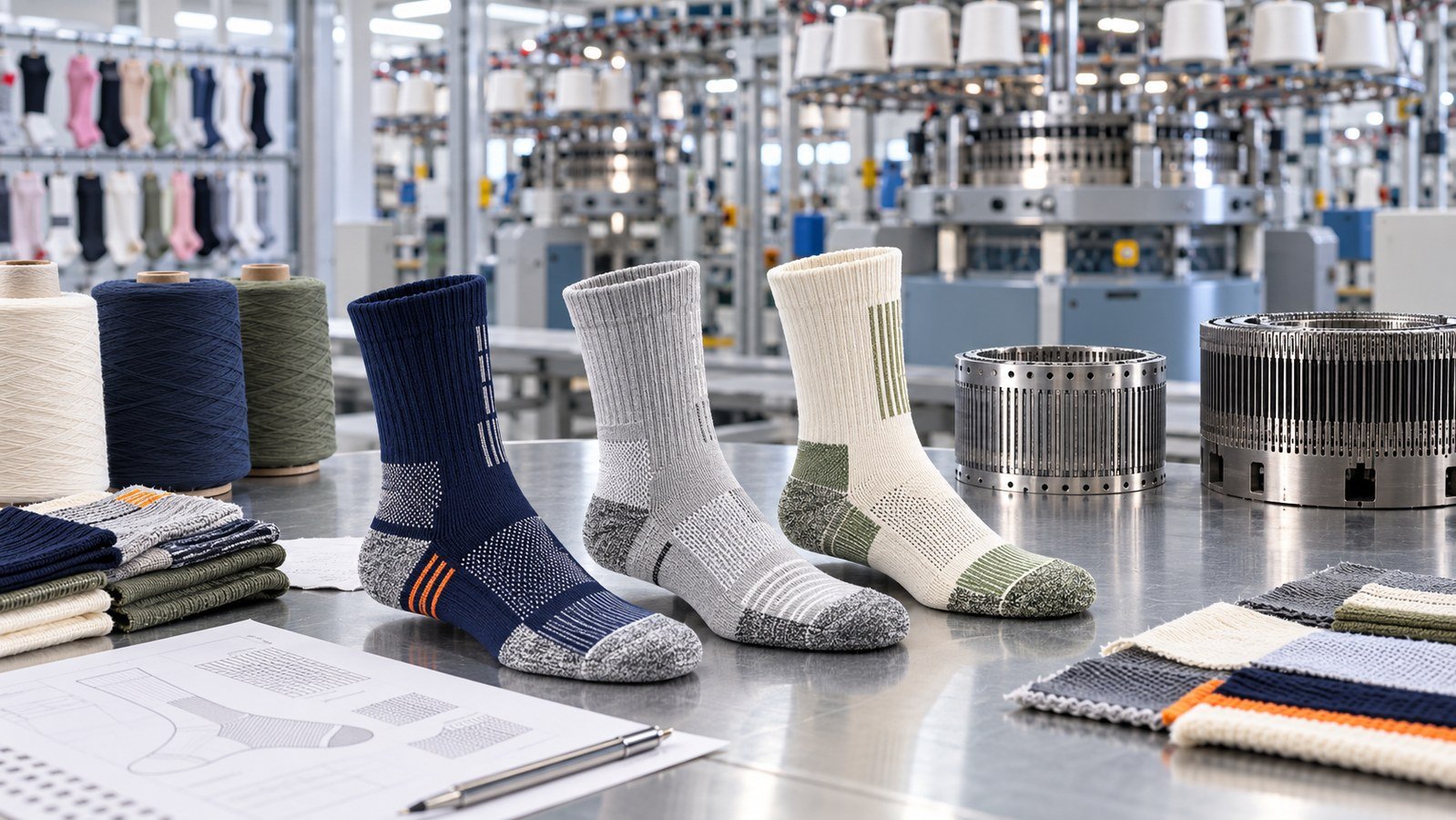
Athletic sock development often begins with visible features: cushioning under the foot, a ribbed leg, mesh ventilation, arch support or a knitted logo. Turning those features into a repeatable product requires a second question: which knitting architecture and machine configuration can form the required structures?
“Single cylinder” and “double cylinder” describe the machine’s needle-bed arrangement. They are useful starting points, but they do not provide a complete capability specification. Gauge, cylinder diameter, needle selection, feeds, sinker system, yarn carriers, software and optional equipment can all change what a particular machine can produce.
This article explains the practical differences for buyers and product developers. It also clarifies why a statement such as “double cylinder cannot make terry” should be treated as a machine-specific production conclusion rather than a universal rule for every model.
The images in this article are privacy-safe technical editorial visuals created from authentic sock-development references. They illustrate machine-selection and construction concepts without reproducing customer designs, specifications or order data.
01. What Single and Double Cylinder Mean
A single-cylinder sock machine uses one circular needle cylinder. Needles move vertically in the cylinder while sinkers and other knitting elements help form and hold the loops. Depending on its configuration, this architecture is widely used for plain knit, jacquard, mesh, cushioning and many athletic sock structures.
A double-cylinder machine has an upper and lower cylinder. Needles or needle elements can work between the two beds to form true rib, Links and related structures. This architecture is valuable when the product requires rib construction or pattern effects that depend on two needle beds.
The number of cylinders does not by itself indicate overall quality. It describes the loop-forming architecture. Product quality still depends on machine condition, programming, yarn control, operator skill, finishing and quality control.
02. Why Athletic Sock Structure Should Be Defined First
Machine selection should follow the intended product structure. Begin by separating the sock into functional zones:
- Cuff and leg structure
- Body knit and ventilation zones
- Instep or arch support
- Heel and toe construction
- Sole cushioning
- Logo and decorative areas
- Compression or reinforcement zones
Then identify which features are essential and which can be adjusted during development. A buyer may request a “thick sports sock,” but the production team still needs to know whether thickness should come from yarn, knitted density, terry loops, padding placement or a combination of these elements.
Development point: define the required knitted result before selecting the machine route.
03. How Terry Cushioning Is Formed
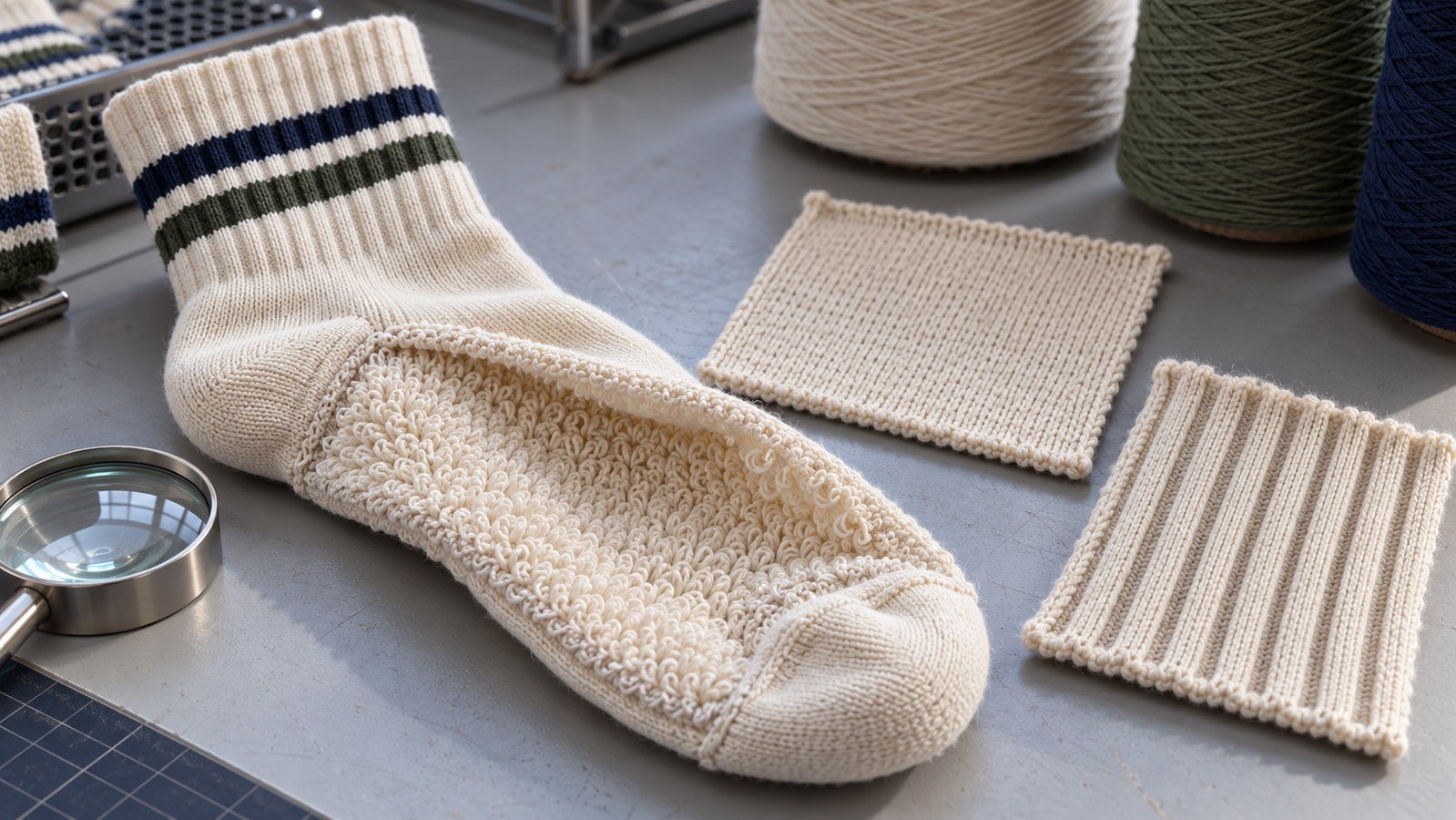
Terry cushioning depends on a compatible loop-forming system, yarn, gauge and machine configuration.
Terry cushioning is created by forming elongated loops, normally on the inside of the sock. These loops add bulk, cushioning and moisture-management surface area. They can be placed across the full foot, under the sole or in selected impact zones.
Terry formation depends on more than the presence of one cylinder. The machine needs a compatible loop-forming arrangement, including the relevant sinker or terry mechanism, yarn feeding and program control. The yarn, gauge and loop length also affect cushioning density, weight, stretch and appearance.
Many athletic terry socks are produced on configured single-cylinder machines because this route can combine selective cushioning with jacquard, mesh and other performance zones. However, buyers should confirm the exact machine model and installed capability instead of treating the cylinder count as the only rule.
When a supplier says a requested construction is not possible on a particular double-cylinder line, the practical reason may be the available sinker system, needle arrangement, gauge, feed configuration or installed options. That conclusion can be valid for the available equipment without proving that every double-cylinder machine has the same limitation.
04. Where Double Cylinder Machines Are Strong
Double-cylinder machines are closely associated with true rib, Links and related structures. These constructions can provide stretch, surface texture and a traditional dress or performance appearance.
Official machine descriptions should be read at model level. For example, Lonati describes its DC88X E1460X double-cylinder machine as suitable for rib, plain knit and Links structures, with tuck knitting available on the lower cylinder. This demonstrates why equipment selection should use the manufacturer’s stated capability rather than a general label alone.
Double-cylinder production may be considered when the design requires:
- True rib structures
- Links or transfer-based pattern effects
- Specific men’s, women’s or children’s sock constructions
- Stretch and surface characteristics associated with two needle beds
- A product already developed for a compatible machine and gauge
The production route should still be confirmed through technical review and sampling.
05. Gauge, Needle Count and Yarn Must Work Together
Gauge describes the needle density or fineness of the knitting setup. A finer setup can support detailed patterns and lighter fabrics, while a coarser setup may suit heavier yarns and more open or robust structures. The exact outcome also depends on cylinder diameter and needle count.
Do not select gauge only from an artwork image. Consider:
- Yarn count and fibre blend
- Required thickness and weight
- Pattern detail
- Stretch and recovery
- Terry or cushioning density
- Mesh and ventilation definition
- Target shoe fit
- Intended wearer and activity
A detailed logo may need more needles for clarity, while a heavy terry construction may require yarn and loop settings that change the usable design resolution. The complete specification must balance appearance, function and manufacturability.
06. Rib, Mesh, Arch Support and Compression Are Different Requirements
Several athletic sock features can look similar in a flat drawing but require different knitted solutions.
Rib is a structural arrangement of knit and purl-type columns. Mesh creates controlled openness for ventilation. Arch support usually uses elastic yarn, tighter stitch settings or a specific construction zone. Compression products require controlled pressure performance and should not be defined only by a visual rib pattern.
When preparing a technical brief, identify the purpose of each zone:
- Decorative texture
- Ventilation
- Cushioning
- Fit retention
- Support
- Reinforcement
- Graduated or targeted compression
This prevents the supplier from treating a functional request as only an appearance requirement.
07. Why Sampling Is the Capability Test
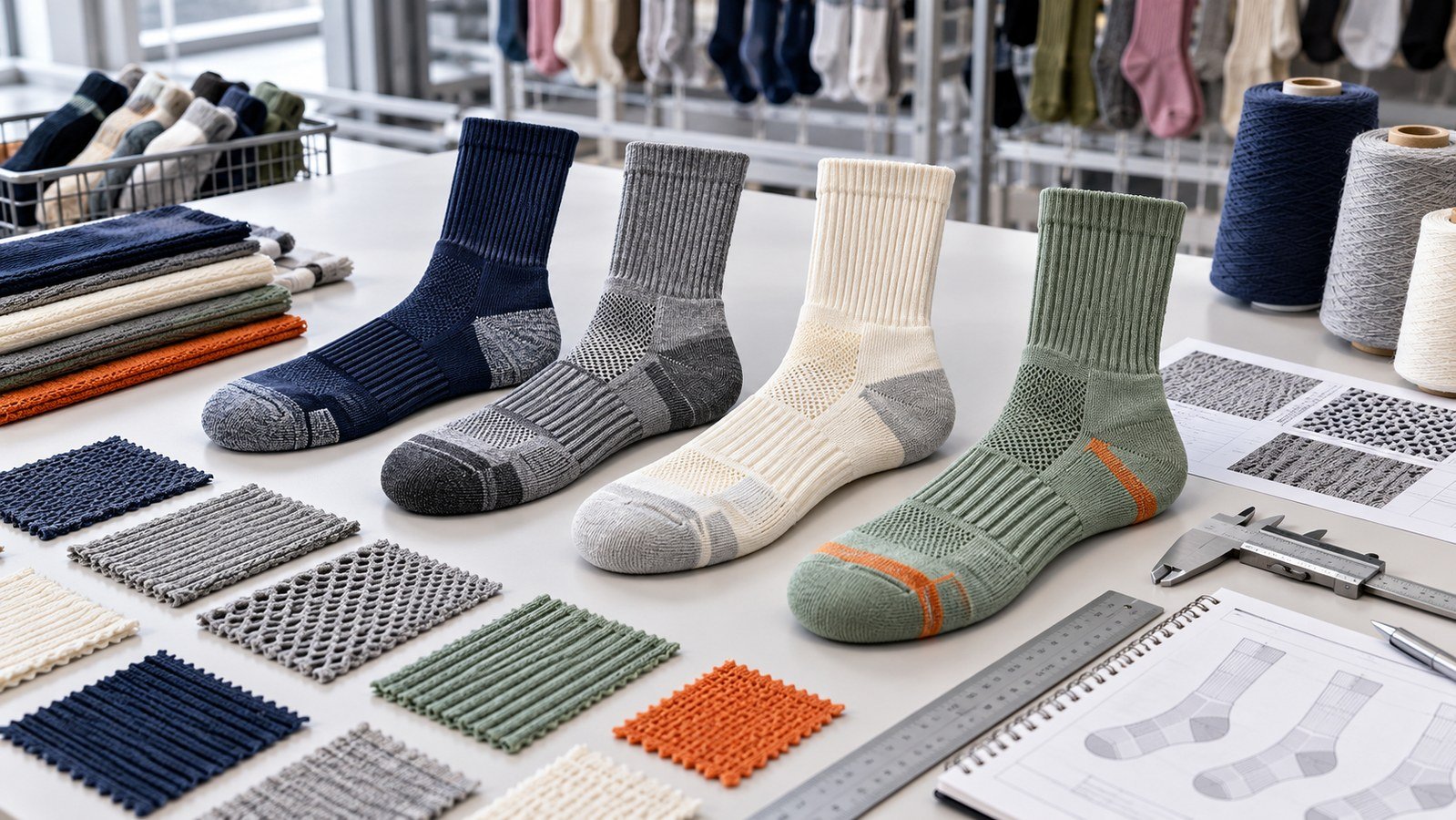
Sampling confirms how the selected machine, yarn, gauge and program work together for the actual design.
A machine list can indicate possible production routes, but the sample confirms how the selected machine, yarn, gauge and program work together for the actual design.
During sampling, check:
- Terry coverage and loop consistency
- Cushioning position and transition
- Rib appearance and stretch
- Mesh clarity
- Logo definition
- Arch-zone placement
- Heel and toe position
- Overall measurements and fit
- Weight, thickness and hand feel
Record any structural change between sample versions. If a pattern, gauge, yarn or machine route changes, recheck the features affected by that decision instead of approving only the overall appearance.
08. Questions Buyers Should Ask a Sock Supplier
Before confirming the production route, ask questions that connect the product to actual equipment:
- Which machine model and gauge are proposed for this design?
- Is the product planned for single- or double-cylinder production, and why?
- How will the terry or cushioning loops be formed?
- Can cushioning be placed selectively or only across a complete area?
- How will rib, mesh, logo and support zones be produced?
- Which yarn counts and materials are compatible with the setup?
- Which details require sampling before they can be confirmed?
- If the structure changes, which measurements or performance points must be reviewed again?
A useful answer should refer to the proposed product and machine configuration, not only state that the factory owns single- or double-cylinder machines.
Practical Machine-Selection Matrix
| Product requirement | Typical technical consideration | Confirmation method |
|---|---|---|
| Terry cushioning | Terry mechanism, sinkers, loop length, yarn and placement | Physical sample and section review |
| True rib | Two-bed capability, rib selection and gauge | Machine specification and sample |
| Mesh ventilation | Needle selection, stitch structure and yarn | Sample appearance and stretch check |
| Knitted logo | Needle count, colour feeds, artwork simplification | Artwork simulation and physical sample |
| Arch support | Elastic yarn, stitch setting and zone position | Measurement, stretch and wear review |
| Heavy athletic sock | Yarn count, terry density, gauge and shoe volume | Weight, thickness, fit and sample approval |
Frequently Asked Questions
Can every single-cylinder sock machine make terry?
No. Terry capability depends on the machine model, sinker or loop-forming system, installed options and production setup. Confirm the exact equipment and sample result.
Is a double-cylinder sock always higher quality?
No. Double cylinder describes a knitting architecture. Quality depends on whether the selected machine and process suit the approved product specification.
Can a buyer choose the machine from a sock photo?
A photo can show appearance, but it may not reveal the internal loops, yarns, stitch structure or machine route. A physical reference, technical brief and supplier review provide better evidence.
Why can two suppliers propose different machines for the same design?
Factories may use different machine models, gauges, installed options and construction methods. Compare the resulting sample, specification, performance and production controls rather than the machine name alone.
What should be approved before bulk production?
Confirm the machine route where relevant, yarns, structure, measurements, artwork, functional zones, approved sample and the quality points that production must repeat.
Single- and double-cylinder machines each support valuable sock structures. The correct choice depends on the product, machine model and installed configuration. For athletic socks, terry, rib, mesh, support and artwork should be reviewed as separate technical requirements and then confirmed together through sampling.
Canfly Knitting supports brands, retailers and private-label sock programmes through technical review, sampling, machine-route selection, manufacturing, quality control, packaging and export coordination. Final capability, minimum quantity, lead time and construction should be confirmed for the individual design.
To discuss an athletic sock project, send the intended use, target market, artwork or reference sample, preferred materials, size range, estimated quantity and required delivery timing.
Email: sales05@zjcanfly.com
WhatsApp: +86 137 3535 0489
Website: www.canflysocks.com